
Introduction
In modern healthcare environments, air is as critical as any medical equipment. One of the most advanced systems hospitals rely on today is the Laminar Air Flow (LAF) system — an engineering solution that ensures highly purified, unidirectional airflow inside critical zones like operation theatres (OTs), ICUs and cleanrooms.
At Medi Clean India, LAF systems are designed using cutting-edge HVAC engineering to deliver sterile, particle-free airflow that significantly reduces airborne contamination and surgical site infections (SSIs).
What is Laminar Air Flow?
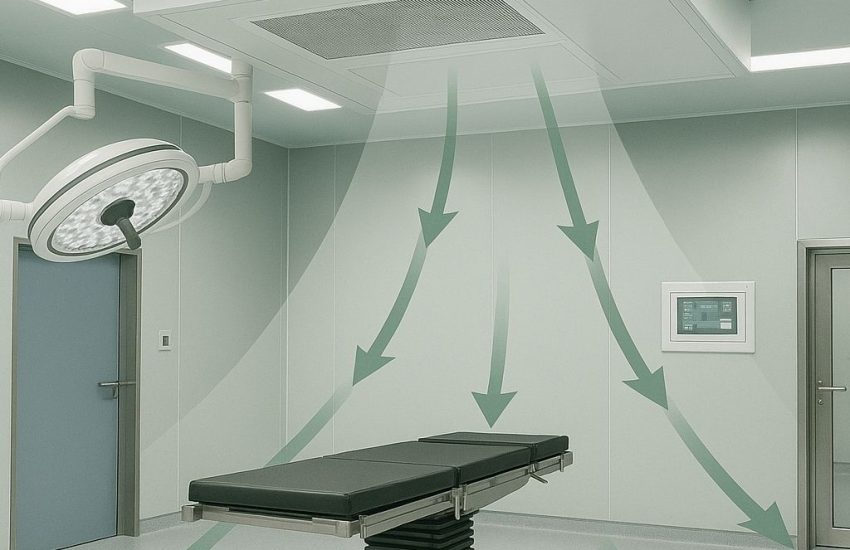
Laminar airflow is a controlled movement of air in a single direction at a uniform speed. Unlike turbulent airflow that mixes particles in the air, LAF ensures particles are pushed away from the sterile zone.
Key Features:
- HEPA Filter (up to 99.97% purification)
- Unidirectional airflow
- Constant positive pressure
- Controlled air velocity (0.3 – 0.45 m/s)
- Sterile, dust-free operational zone
How Does It Work?
1. Fresh Air Intake
Outdoor air is drawn in through pre-filters.
2. HEPA Filtration
Air passes through HEPA or ULPA filters that remove micro-particles, bacteria, and viruses.
3. Uniform Airflow
Air flows downward (vertical LAF) directly over the surgical table.
4. Exhaust & Recirculation
Contaminated air exits through low-level grills or ducts.
This precise movement creates a sterile air zone directly around the patient and surgical team.
Why Hospitals Need LAF Systems
✔ Prevents Airborne Infections
More than 20% of SSIs occur due to airborne contamination. LAF prevents bacteria from settling in critical areas.
✔ Ensures Sterile Surgical Environment
It keeps dust, fungal spores, and contaminated aerosols away from the wound site.
✔ Meets NABH & International Standards
A mandatory requirement for Modular OTs and high-risk surgical environments.
✔ Enhances Patient Safety
Better airflow = better outcomes.
Types of Laminar Air Flow Systems
1. Vertical Laminar Flow
Air flows from ceiling to floor; ideal for OTs.
2. Horizontal Laminar Flow
Air flows from one wall to the opposite wall; usually used in cleanrooms.
LAF in Modular Operation Theatres
Medi Clean India integrates LAF:
- In OT ceilings
- With surgical lights
- With pressure monitoring systems
- With HEPA boxes & ducts
This creates a fully controlled and sterile environment.
Maintenance Tips
- Replace HEPA filters every 6–12 months
- Calibrate air velocity regularly
- Check pressure differentials daily
- Validate airflow (DOP test) annually
Conclusion
Laminar Air Flow systems are the backbone of modern hospital engineering. They ensure patient safety, meet global standards, and protect both staff and surgeons. For healthcare facilities looking to upgrade their OT safety, LAF systems from Medi Clean India provide unmatched reliability and engineering precision.
